Put the coverage deadline on the first page
Write down when your current policy ends and why you are shopping. If you received a cancellation or nonrenewal notice, keep the complete notice, including its date and stated reason. A verbal summary such as “they are dropping us” does not tell an agent whether coverage is ending during the term or at renewal.
Add your best contact information and the property address. Include the desired effective date, but distinguish that request from coverage that has already been confirmed. If a mortgage company has sent a notice about missing insurance, attach it and identify its response deadline.
Contact agents while collecting documents and identify pending items. Waiting for one nonessential invoice should not consume the time needed to review a suitable policy.
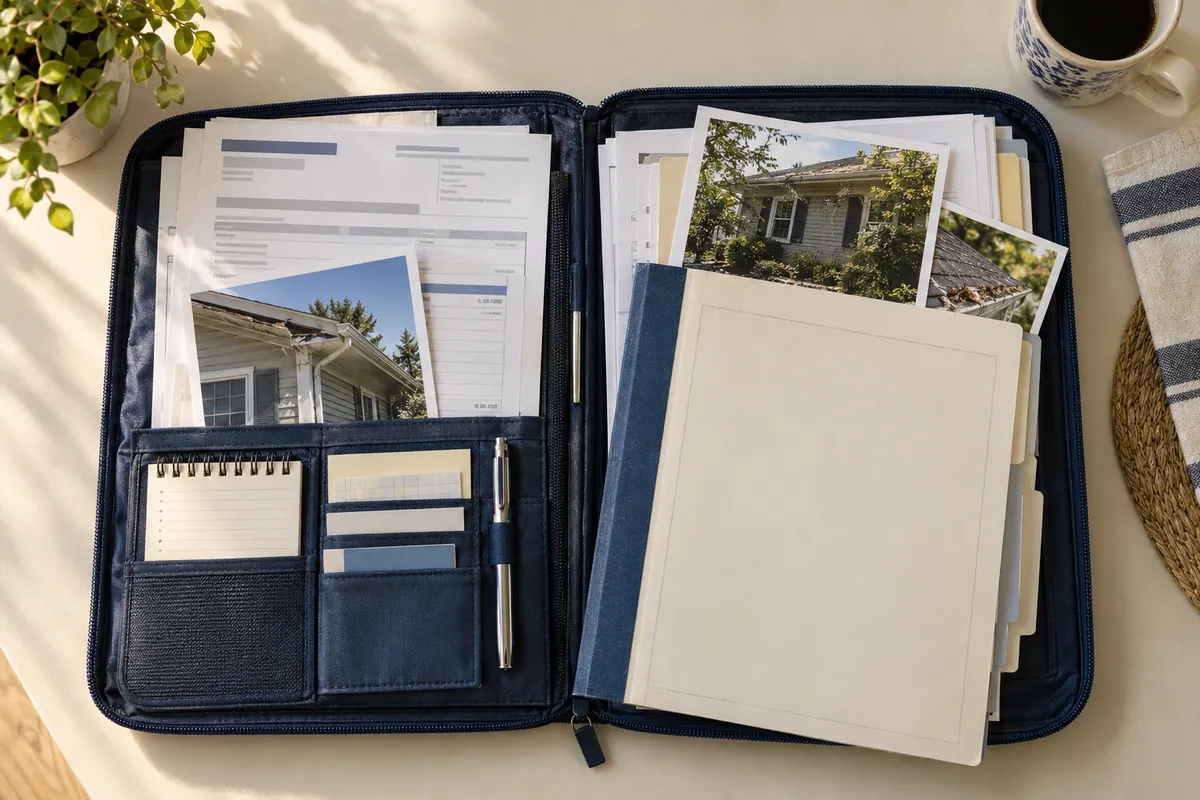
Build a packet with six clearly labeled parts
| Part | Include | Check before sharing |
|---|---|---|
| 1. Coverage deadline | Current declarations page and any termination notice | Effective dates, property address, and stated reason |
| 2. Property facts | Occupancy, construction details, roof information, and current work | Actual conditions rather than intended future conditions |
| 3. Loss summary | One row for each event with claim number and status | Dates and amounts agree with available records |
| 4. Repair evidence | Invoices, photographs, permits, and applicable approvals | Completed work is separate from estimates and proposals |
| 5. Open questions | Pending claim issues and reporting disputes | Each question has a contact and a requested document |
| 6. Coverage priorities | Desired protection, deductible budget, and mortgage information | Important needs are visible before price comparison |
Use ordinary filenames such as “roof-final-invoice” or “water-claim-closure-letter.” Keep original documents intact. Group photographs by claim so the connection is clear.
Record property facts without guessing
List whether the house is your primary residence, a rental, a seasonal home, or currently unoccupied. Note any construction or unrepaired damage. If the use is changing, describe both the current situation and the planned change with its expected timing.
For the roof and major systems, distinguish known dates from estimates. A roofing invoice is stronger evidence of installation than a recollection that the roof is “about ten years old.” If only part of a system was replaced, identify the part. Do not describe a full plumbing replacement when the work involved a single bathroom.
Ask which additional details prospective insurers need before paying for new inspections or records.
Create a factual chronology for each loss
Use a simple sequence: event, immediate response, insurer status, repairs, and current condition. Keep it short enough to read quickly. Identify the source of technical findings, and state when a cause or payment amount is still unconfirmed.
Example of a concise loss chronology
The following is a fictional example showing a useful level of detail. It is not a statement about a particular homeowner or an example of guaranteed eligibility.
- March 6, 2025: Water was found beneath the kitchen sink. The plumber’s invoice identifies a failed supply connection.
- March 6, 2025: The supply was shut off and the damaged connection replaced.
- March 9, 2025: The insurer’s adjuster inspected the affected cabinet and flooring.
- April 2, 2025: The contractor completed the cabinet and flooring repairs. The final invoice and completion photographs are available.
- April 15, 2025: The insurer’s letter states that the claim is closed. The payment amount is recorded separately from the total repair cost.
- Current condition: The kitchen is in regular use. No additional damage from that event has been observed by the homeowner.
The last sentence reports an observation rather than promising that hidden damage is impossible. That distinction keeps the explanation accurate. If a contractor has issued a separate finding, attach it and describe what the contractor actually evaluated.
Repeat the format for separate events. Do not combine two losses because they involved the same area, and do not treat a later supplemental payment as a new date of loss. Ask the insurer to clarify any confusing entries.
Reconcile claims records before signing an application
Request your consumer claims history report if you need to review what may be reported about you or the property. The CFPB identifies LexisNexis CLUE as a source of home insurance claims information and explains how consumers can request their reports. Keep insurer letters available to compare against the entries.
Look for the wrong address, an unfamiliar loss, a duplicate-looking entry, or a status that conflicts with current correspondence. If something is wrong, identify the exact entry and supporting evidence in a dispute. Tell the agent when a correction is pending rather than presenting the record as already changed.
A reporting period and an application’s questions are not necessarily identical. Read the requested time period and scope carefully. Do not omit a known event just because you do not see it on a particular report. Ask the agent for clarification if a question is ambiguous.
Separate completed work from plans and estimates
Create two groups within the repair folder: completed work and outstanding work. An estimate belongs in the second group until the work is done. Include a proposed schedule when available, but do not label a contractor’s expected completion date as a guaranteed date.
For completed work, pair the invoice with relevant photographs and any required approval already obtained. For an open claim, keep the insurer’s latest status explanation nearby. The agent should be able to see whether the open issue involves payment, remaining repairs, personal property, or something else.
If you cannot find an old invoice, ask the contractor for a copy. Explain the gap to the agent and ask what alternative evidence is acceptable. Avoid creating your own document that looks like a contractor certificate or changing the wording of a third party’s report.
Decide what protection you need before comparing prices
Write down coverage priorities in plain language. Examples include replacement cost protection for the dwelling, the treatment of roof claims, coverage for personal belongings, temporary living expenses, and personal liability. Note separate flood or wind coverage that should be reviewed for your location.
Set a realistic deductible budget using money you could access after a loss. If an offer uses a percentage deductible, ask the agent to convert it to dollars. Keep separate deductibles visible so an attractive standard deductible does not obscure a much larger storm deductible.
Provide the current mortgage information and ask the lender about its requirements where needed. The amount owed on the loan is not automatically the correct dwelling insurance limit. Ask how the replacement cost estimate was developed and review the property details used in it.
Track submissions and compare written offers
Keep a brief shopping log with the agent, company, submission date, response, and next requested item. If more than one agent is involved, ask them to identify the markets they are approaching. Share corrections consistently so later submissions do not repeat an error you already found.
For each offer, record the annual premium, separately disclosed fees, dwelling limit, deductible, roof settlement, water restrictions, and any repair conditions. Ask for the relevant policy forms when a material term is unclear. A comparison should identify what protection changes along with the price.
If a company declines, note the reason and whether additional information could change the review. That record helps the next conversation focus on an available path rather than repeating an unsuccessful application without any new facts.
Complete the final review before changing coverage
- Read the application and correct inaccurate answers before signing.
- Confirm the insurer, insured address, occupancy, limits, and deductibles.
- Identify any outstanding underwriting or inspection conditions.
- Get written evidence of coverage and verify the effective date.
- Coordinate mortgage documentation and the ending of the old policy.
- Save the final policy and calendar any required follow-up.
Keep the packet for future renewals and questions about earlier repairs.
Continue with a related guide
Frequently asked questions
What should I send an agent first after claims?
Start with the property address, current coverage deadline, any nonrenewal or cancellation notice, and a short loss summary. Include the current declarations page if available. Ask which additional records are needed for the companies that can consider your situation.
Do I need every repair document before calling?
No. Start the search while collecting documents, especially if coverage is ending. Explain what you already have and what you are requesting. The agent can identify missing items that are actually necessary for review.
Should I include claims that paid nothing?
Answer the application’s actual questions accurately. A zero-payment claim may still be relevant to a question about reported losses or claims. Do not assume payment amount determines whether disclosure is required; ask for clarification when the wording is unclear.
What if I do not remember an exact loss date?
Check insurer correspondence or request the claim record. Mark an uncertain date as unconfirmed while gathering evidence. Avoid turning an approximation into a precise answer on a signed application without telling the agent.
Are photographs enough to prove repairs were completed?
Photographs can help show current condition, but they may not establish what work was performed. Include invoices and applicable inspection records where available. Ask the insurer what documentation it requires for the particular loss.
How should I describe a claim that is still open?
Use the insurer’s latest confirmed status and explain what remains unresolved. Separate unpaid amounts or personal property issues from unfinished building repairs. Attach the relevant correspondence so the agent does not have to infer the reason.
What should I compare besides the premium?
Compare limits, deductibles, roof settlement, water restrictions, liability protection, living expense coverage, fees, and repair conditions. Review separate flood or wind needs for the location. Ask for written clarification of terms that materially change your protection.
When can I cancel my old homeowners policy?
First obtain written evidence of the replacement coverage and verify when it starts. Then coordinate the cancellation date and mortgage documentation. A quote, submitted application, or requested start date does not by itself confirm that coverage is in force.
Consumer resources
These resources provide background. State-specific examples do not create a nationwide rule.